On the occasion of India's Independence Day and exactly a week before I leave India to pursue my master's I only thought it fitting that my post be about India.
Wednesday, 15 August 2012


Poem: The India that I dream of
The India that
I dream of
is one where
no one needs to sleep hungry
the India that
I dream of
is not
limited to narrow metrics like the GDP and the Gini
but, is an
India where a certain satisfaction and dignity of life is assured
the India
that I dream of
is a country
where her people are happy, and children educated
the India
that I dream of
is one where
you cannot be evicted from your land and your livelihood stolen
because you
stand in the way of this certain idea of ‘development’
but one
where will only move out of your own vocation
the India
that I dream of
is one where
any religion (or none) can be practiced
without fear
and with one’s head held high
the India that
I dream of
is one where
we can also accept a contrary option
and everyone’s
concerns are taken care of
the India
that I dream of
is not a
military superpower
but a
country strong enough to defend herself if need be
the India that I dream of
is a country which allows you to be different
the India that I dream of
is a country which allows you to be different
the India
that I dream of
is one where
we are at peace
not just
with ourselves but also with those around us
but most of
all the India that I dream of
is one where all her children are truly free.
Mukund Palat
Rao
(August 15,
2012)
Friday, 25 May 2012
What does it mean to be an 'environmentalist'?
What does it mean to be an 'environmentalist'?
I believe being an environmentalist is about living life with an increased level of consciousness, wherein, we try to live with an in-depth understanding of the choices we make, our actions and their consequences on the society and on the environment.
Let us take the example of an action that we often witness, which is of throwing away an empty PET (polyethylene terephthalate) bottle on the side of the road after consuming a soft drink. Many among us just do not pay heed to the fact that there is a high possibility that the bottle could remain there for years and years to come primarily because of slow biodegradability of PET. Before mindlessly throwing away batteries it is imperative that one should be aware of the heavy metals like lead present in them and how they contaminate the soil. As Rachel Carson has clearly explained in her book, ‘The Silent Spring’, a seemingly harmless act of spraying pesticides in one’s garden or agricultural field has potentially calamitous effects on the local eco-system. Hence, being an environmentalist is primarily about living with an increased level of consciousness.
The role of an environmentalist is also to help society awaken to the realisation that our present lifestyle is absolutely unsustainable. The way to achieve this is through education. It is important that an environmentalist helps those around to understand that we are a part of the biosphere and not outside it, and will therefore have to face the repercussions of our own actions.
Another practice that I feel is central to the philosophy of being an environmentalist is one of ‘live and let live’. Often, in the zealous pursuit of trying to conserve the environment people do more harm than good. Take the example of a nature photographer. In the attempt at getting the perfect shot they often tend to disturb and put at risk the very wildlife they claim to be trying to protect. The beauty of nature is in being a part of it and not in trying to manipulate it to serve our selfish pursuits.
In the same vein, a true environmentalist should try to ensure that his or her actions do not in any way achieve the opposite of what they are trying to accomplish. For example, before engaging in a tree plantation drive one must ensure that the tree species chosen for planting are suitable to the locality.
Being an environmentalist should not be an attempted act of ‘greenwashing’ wherein one can assuage oneself by saying that having taken part in a tree plantation campaign, it is fine to cool off in an air-conditioned room all day. Being an environmentalist is about accepting and adopting a way of life which is not in conflict with the environment. It is a continuing endeavour to contribute towards developing a sustainable society, with a fraternity of humankind; at peace with the surroundings, and using resources in a sustainable manner.
After having studied Chemical Engineering at my Bachelor’s program, I have observed that the industry predominantly remains dependent on non-renewable sources of energy like coal and petroleum for its energy requirements. These energy sources continue to contribute towards global warming. From this, I have come to understand that environmentalism must be rooted both in science and society. Mere activism cannot be an answer to our problems. Theories and premises must have a strong backing with facts and scientific methods. Only then will people believe in the veracity of our claims and the genuineness of our intent. Thus, being an environmentalist is not just being guided by high ideals but also demands good training and experience which must be rooted in one's day to day life.
Mukund Palat Rao
Saturday, 24 March 2012
A peek into the next few updates
The next update would probably be an interview I'd conducted of Dr. R.K Pachauri who is the Director General of TERI and the Chairman of the IPCC.
In line after that would be a write up about a paper bag making workshop that I will be conducting at my University next week in the run-up to the celebrations for Earth Hour.
The link below will take you to an article which appeared in 'The Hindu', which briefly mentioned me in reference to the celebration of World Poetry Day in Coimbatore on March 21st in Coimbatore.
http://www.thehindu.com/life-and-style/metroplus/article3154834.ece
In line after that would be a write up about a paper bag making workshop that I will be conducting at my University next week in the run-up to the celebrations for Earth Hour.
The link below will take you to an article which appeared in 'The Hindu', which briefly mentioned me in reference to the celebration of World Poetry Day in Coimbatore on March 21st in Coimbatore.
http://www.thehindu.com/life-and-style/metroplus/article3154834.ece
Friday, 24 February 2012
Poem: The Future?
The Future?
There
was a man, who once went out to sea,
He sailed to the Arctic,
And found it bereft of ice,
Then he stayed till the winter,
To discovered it was no longer cold,
And from there when he moved to Europe,
He discovered it uninhabited, with not even the old,
All that remained was ice, melt, death and uncommon cold.
He then travelled to the east,
From the Occident to the Orient,
He passed by India,
With its immense masses standing reduced,
Droughts in some parts and floods in the others,
But everywhere malaise and hunger had taken their toll.
From there to the South China Sea he went,
Which was fuming and frothing,
With typhoons raging,
And on reaching South America, he found the Amazon was gone,
No more squirrel monkeys, and no more macaws,
None left of the caiman and neither the poison arrow frogs.
On exploring further,
He found that all the humans had killed each other off,
They’d left Earth in a wretched mess of radioactive waste,
And had murdered themselves in coercing their enemies for
fossil fuels,
They’d bombed the countries to their left and the countries
to their right,
And they'd bombed and they'd shelled until they themselves were blown-up
and damned.
Slowly now the mist has begun to clear,
When I told someone about my dream they told me they’d had
the same dream,
Maybe I wasn’t just hallucinating,
This might be the future if went on this way,
And it’ll be just foolish if in spite of knowing the
consequences we still don’t change.
Mukund Palat Rao (February 23, 2012)
Surface heat and fresh water fluxes causes density gradients in the oceans of the world. This results in oceanic circulations which are also called thermohaline circulations. These thermohaline circulations are also called the ocean conveyor belt. Higher salinity and colder temperatures result in an increase in the density of water. It has been postulated that if for some reason if these oceanic circulations were to cease then Europe could descend back into the midst of an ice-age. This explains the reason as to why I have chosen to portray Europe to be in the throngs of an ice-age. A little reading on the topics of the Younger Dryas and thermohaline circulations might help the reader gain a better insight into these potentially catastrophic consequences.
Wednesday, 9 November 2011
Poem : The Rain Dance
The Rain Dance
I sit next to the window pane,
The rain, it has started once again,
The mist and froth blows across my face,
And the rain drops fall down like beads on a lace.
A crow pheasant sits in my neighbour’s garage,
Drying herself after the rain disturbed her plumage,
And the old and yellow leaves of my jackfruit tree have
begun to fall,
Twisting, twirling and dancing through it all.
The blue mountains play their game of hide and seek,
With the clouds hiding them and filling up their creeks,
And the frogs and toads seems to croak on and on,
Oblivious of my grandmother’s disapproving frown.
With all this beauty around,
There is no place else I’ll sit than the one I have found,
And there is nothing else I’d rather do,
Than sit and write poetry for me and you.
Mukund Palat Rao
(August 27, 2011)
Saturday, 24 September 2011
“It really doesn’t matter that much”
“It really doesn’t matter that much”
Is climate change for real? Are the oceans really rising
and the glaciers shrinking? While most of would definitely answer the above questions
in the affirmative there are still many amongst us who would still say that they aren’t
that sure. They call themselves the ‘Climate Change Sceptics’.
As has been rightly pointed out if we look at the history of mass extinctions we would learn that right now we are in the midst of the sixth major mass extinction. So, obviously there have been changes in the earth’s climate before this right? Yes, that is true; but that’s not the whole story.
As has been rightly pointed out if we look at the history of mass extinctions we would learn that right now we are in the midst of the sixth major mass extinction. So, obviously there have been changes in the earth’s climate before this right? Yes, that is true; but that’s not the whole story.
It has been estimated that within the last five hundred years,
at least eighty mammal species have gone extinct; this from a starting total of
approximately 5,570 species. Now compare this to the average extinction rate
for mammals of less than two for every million years. I am sure you don’t need
any help with the math; it’s clear as daylight that the present rate of
extinction is far greater than the average extinction rate previously. The
other question is the reason behind this extinction? I’m am pretty sure,
climate sceptic or not there is absolutely no doubt that this extinction is
anthropogenic. In case of any lingering doubts one can easily check into the
history behind the extinction of the dodos, the Javan and the Caspian tigers,
the cheetahs in India and numerous other plant and animal species (even if the
example was about the extinction of mammals this phenomenon is not limited to
mammals alone).
Then should you be worried?
Allow me to digress a bit and explain this with a short story. There is an oft
quoted example where the earth is compared to an aeroplane and human beings to mechanics.
We sit inside the aeroplane and then slowly start to unfasten all the screws in
the whole aeroplane. Let us say, we start from the inside first and get rid of
all the seats. No doubt the aeroplane will still fly. We then continue our
experiment for a little while further and keep testing each time if the
aeroplane still flies. Slowly once we had rid ourselves of all trivial screws
we will eventually need to start medalling with the screws that keep the whole
structure together. Eventually we reach a point where every new screw
unfastened could be our last. If we go ahead and unscrew both engines the
result is quite obvious. It isn’t going to matter that there are still so many
screws left to unfasten. The whole system is definitely going to crash. Now, to
explaining why I used this metaphor. Compare each screw lost to a species gone.
The disappearance of one species isn’t obviously going to bring to whole
eco-system down. However, slowly as more species start to disappear the web of
life would start to become unsustainable. The predator-prey relationships would
begin to become skewed favouring one side over the other, in the end leading to
a dramatic collapse of the whole complex web of life. This is not taking into
account the fact that most niche species and species in symbiotic relationships
would be dead long before we ever got to this stage.
 | |
|
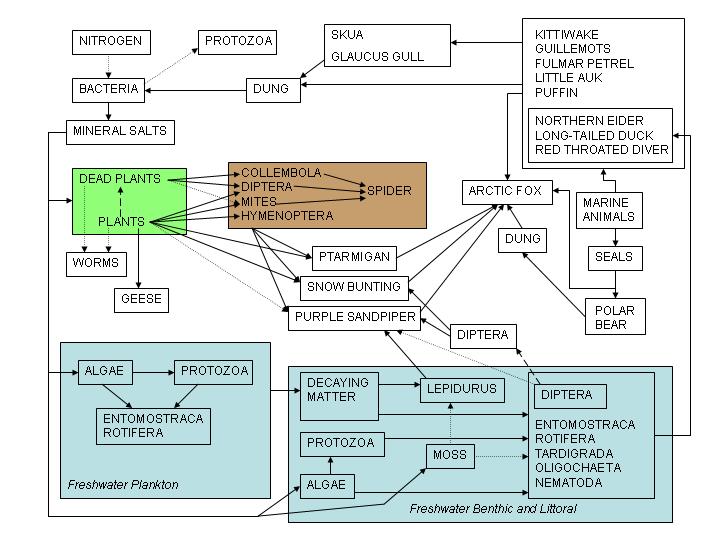 |
| Victor Summerhayes and Charles Elton's 1923 food web of Bear Island |
| http://en.wikipedia.org/wiki/File:EltonFW.jpg |
Then is conservation important? Altruism isn’t a trait
everyone is blessed with. Why worry about saving the earth, conserving minerals
and electricity etc.? If I have the money then what pray is your problem, aye?
The wars on oil don’t directly affect me; they are being fought in far-away
lands. Just ensure that it still remains affordable and cheap. Kill as many as
you want for it! Why should the displacement of tribal people in some distant
and remote place bother me? I need those rare earth metals, for my music player
to work don’t I?
There are economists who claim that the cost of investing into green and eco-friendly technologies will cripple us so much that financially most large industries will have to shut shop. I don’t claim to know too much economics but I am sure that money spent on investing in better effluent discharge, better energy efficiencies etc. will probably do more good than harm. It has been proven worldwide that it is better to invest in more efficient technology now and pay less every month on maintenance than ending up footing higher recurring costs. If you add to it other benefits like lower particulate emissions, and less toxic discharges, it makes more sense to go green than to resist. The motivation really doesn’t matter; you could be an environmentalist or be in it for selfish reasons of leading a more luxurious life. It is better to conserve now and have something for the future. Think of it as an investment. What is likely to be in high demand a decade from now will also obviously also fetch you a good price a decade from now too.
Here is one of the most persuasive
letters to the editor I have read in recent times. The reply was to an article
by Friedman in the New York Times titled, “Is it Weird Enough Yet?” Here is an
excerpt from it;
“The French philosopher and mathematician Blaise Pascal, in what has
become known as Pascal’s wager, suggested that even people who did not believe
in God should act as if they did, since being wrong could be catastrophic.
I would say to the climate skeptics[sic]: If you do not believe in climate
change but act as if you did, even if you are right, the result would be a
society with clean, sustainable jobs, less dependence on Mideast oil and
healthier lives. But if you are wrong and we do not act immediately, the
results would be catastrophic.”
PHILLIP GOTTSCHALK
Montville, N.J., Sept. 14, 2011
Montville, N.J., Sept. 14, 2011
Mukund Palat Rao
(September 20, 2011)
P.S Here is two interesting videos you might like to
watch
The first video is
from the Rio Summit of ’92.
Subscribe to:
Posts (Atom)